
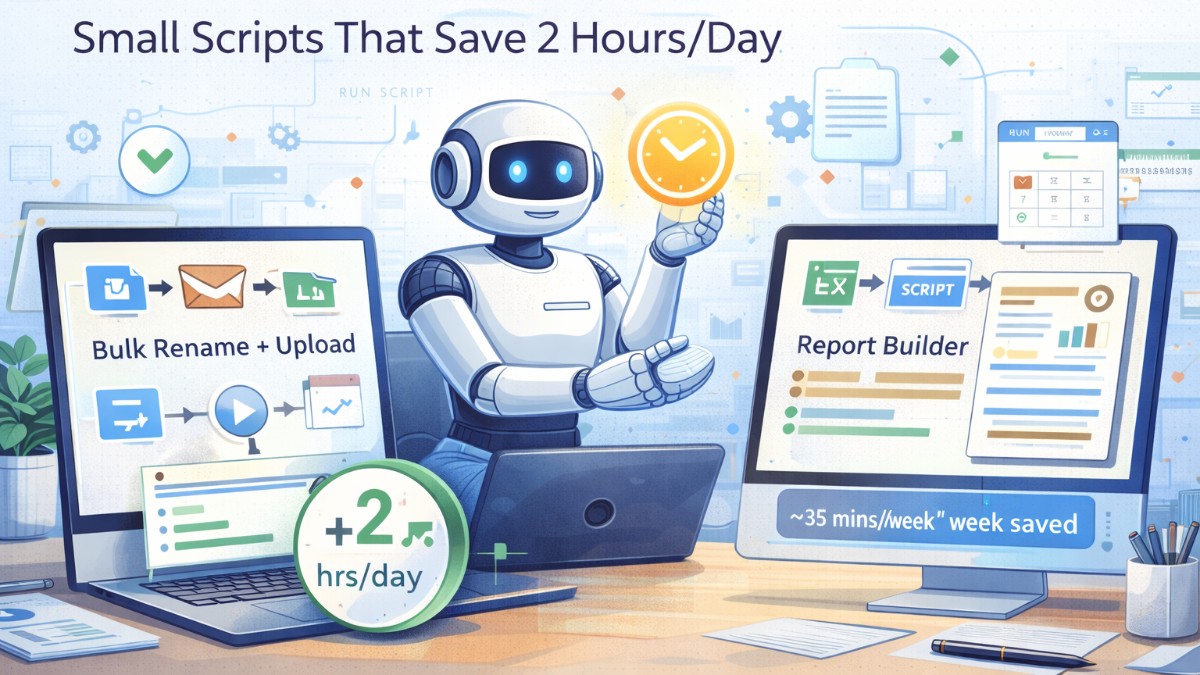
The biggest productivity breakthroughs are quietly small.
In many teams, “automation” still sounds like a major project: approvals, architecture, months of work, and a dashboard nobody maintains.
But the most consistent time-savers today are not giant systems. They’re micro-automations—small scripts, templates, and lightweight workflows that shave off 3–10 minutes at a time.
Do that a few times a day and suddenly:
You’ve bought back 2 hours—every day—without asking for headcount.
Micro-automations are becoming a career advantage because they prove a rare skill: you can remove friction from real work.
What is a micro-automation?
A micro-automation is a tiny workflow that:
eliminates a repeat task
runs in seconds
requires minimal setup
is easy to maintain
produces a reliable output
It can be as simple as:
a script that renames and uploads files in the right format
an email template generator from a spreadsheet
a one-click report export and merge
auto-formatting a weekly tracker
cleaning raw data and generating a summary
Not glamorous. Extremely valuable.
Why micro-automations are exploding in 2026
Three reasons:
1) Work got heavier, not lighter
Teams are leaner. Ops workload increased. Deadlines didn’t move.
Micro-automations help people survive operational load without burnout.
2) AI made “first drafts” cheap
AI can write a draft email, a draft report, a draft script—but the real win is when you turn that draft into a repeatable workflow.
3) Proof-of-skill hiring rewards impact
Micro-automations create measurable results:
time saved
errors reduced
turnaround improved
This is the kind of proof that looks good on a skill scorecard.
The 2-Hour Rule: how to find automation opportunities
Here’s a simple way to identify high-impact micro-automations:
Track your repeats for 3 days
For every repeat task, note:
task name
frequency/day
minutes each time
error rate (“I often miss something”)
Then apply this filter:
If it happens 3+ times/week, it’s a candidate.
If it takes 5+ minutes, it’s a high-value candidate.
Micro-automation examples (real work, real savings)
1) “Report Builder”
Problem: weekly report takes 40 minutes of copy-paste
Micro-automation: script pulls numbers + formats into a ready summary
Impact: 35 minutes saved/week per person
2) “Invoice / Claim Validator”
Problem: manual checks miss fields, cause rework
Micro-automation: auto-checks required fields, flags exceptions
Impact: fewer errors, faster closure
3) “Meeting Notes → Action Items”
Problem: action items get lost
Micro-automation: converts notes to tasks + owners + due dates
Impact: better follow-through, fewer misses
4) “Bulk Rename + Upload”
Problem: teams upload files in wrong naming convention
Micro-automation: rename + sort + upload in one click
Impact: avoids back-and-forth
5) “Customer Response Templates”
Problem: repetitive customer replies drain time
Micro-automation: fills templates with variables (name, issue, ETA)
Impact: consistent communication + speed
These are not “tech projects.” They are operational upgrades.
A simple framework to build micro-automations safely
Micro-automations should be safe, explainable, and easy to handover.
Step 1: Define input → output
Write it in one line:
Input: (CSV, email, folder, form)
Output: (report, cleaned file, message draft, updated sheet)
Step 2: Add guardrails
Your automation must handle:
missing values
wrong formats
duplicates
“do nothing” safely if input is invalid
A good automation fails safely. A bad one fails silently.
Step 3: Make it repeatable
one command
one button
one workflow trigger
Step 4: Log and measure
Keep a basic record:
date
run count
time saved estimate
errors prevented
This becomes your proof later.
The career advantage: micro-automations are proof of impact
Hiring is shifting toward “show me what you improved.”
Micro-automations give you:
a story (what problem existed)
an artifact (script, workflow, template)
a measurable outcome (time saved, errors reduced)
In skill-first hiring, impact beats intention.
Put it on your scorecard like this:
Automation Skill: Built 4 micro-automations for reporting and validation
Outcome: Saved ~8 hours/week across the team
Proof: Repo + demo + before/after metrics
That’s stronger than “I am hardworking.”
The hidden benefit: you become the “multiplier”
Every team has:
doers (they work hard)
multipliers (they remove friction for everyone)
Micro-automations move you into the second category.
And multipliers get:
visibility
trust
better roles
Closing
The future of work isn’t only about big AI platforms. It’s also about the small, repeatable upgrades you create in the flow of real work.
Micro-automations are the new baseline skill—because everyone is busy, and time is the most expensive resource.
Save 5 minutes repeatedly, and you change your week.
Save 2 hours a day, and you change your career.