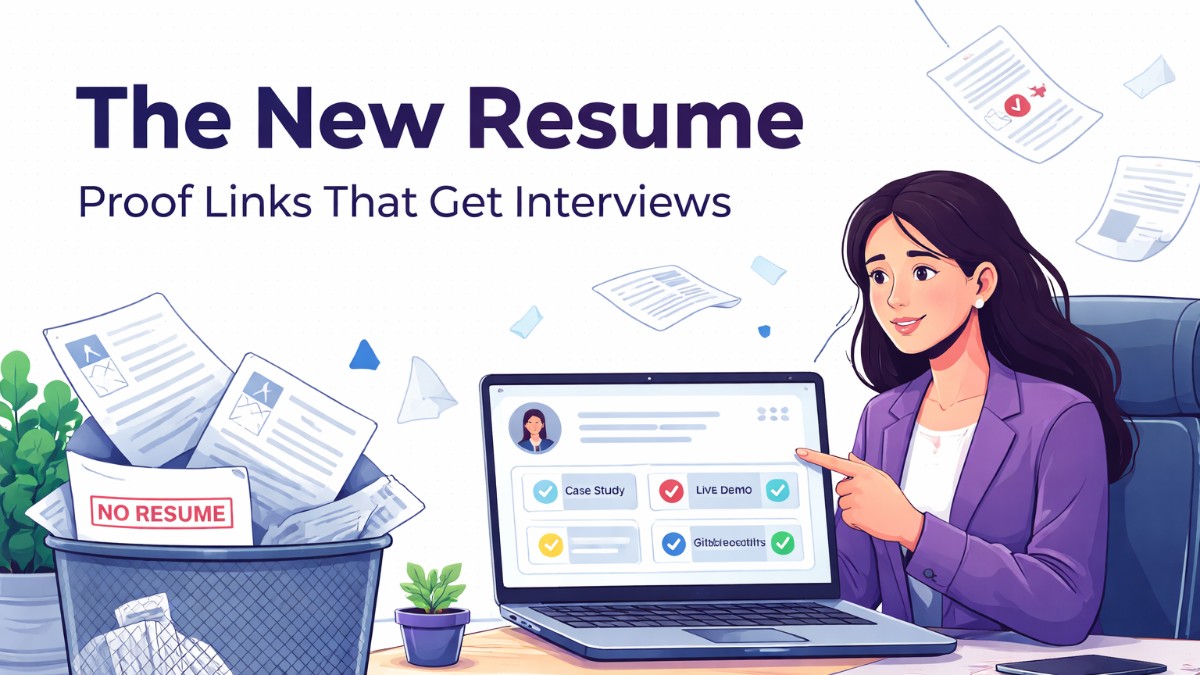
Your resume isn’t being “read” anymore. It’s being verified.
In 2026, most recruiters don’t open a 2-page PDF and slowly admire your formatting. They skim, they scan, they shortlist—and they do it with one question in mind:
“Can I trust this person’s claims fast?”
That’s why the new resume is not a document.
It’s a stack of proof links.
If you’ve ever wondered why some candidates get calls even with average resumes, while others with fancy templates get ignored—this is often the reason: the first group has clickable proof.
What changed in hiring (quietly, but permanently)
Three shifts have reduced the power of resume words:
Too many applicants, too little time
Recruiters can’t deeply read 500 resumes. They filter, then verify.AI made “good writing” cheap
Great summaries, polished bullet points, and “impact lines” are easy to generate now. Words aren’t rare. Proof is.Signal beats storytelling
Hiring is moving from “tell me” to “show me”—especially for early and mid-level roles.
In 2026, credibility is a feature.
Proof links are how you ship it.
The Proof Link Stack (what recruiters actually click)
Not every link helps. Some links actively hurt (we’ll cover that). But recruiters consistently click these because they quickly answer: Can this person deliver?
1) A “Proof-of-Work” landing page (your hub)
This is your new resume homepage. A simple page with:
who you are + what roles you want
your top 3 proof items (links)
your skill scorecard (more on this later)
contact info
It can be:
a Notion page
a simple website
a GitHub profile with pinned repos (but organized)
Recruiter reaction: “Nice. Everything is in one place.”
2) One strong case study (not a project dump)
A case study beats a project list because it shows thinking.
A good case study has:
Context: problem + who it affects
Your role: what you owned
Constraints: time, tools, data limitations
Actions: what you did (step-by-step)
Result: measurable output
Lessons: what you’d do better next time
A case study is proof that you can work like an employee, not just learn like a student.
3) A demo link (fast verification)
Recruiters love anything they can verify in under 30 seconds:
live demo site
short walkthrough video
hosted dashboard
interactive notebook (for analytics roles)
If your demo takes 3 minutes to load, needs a login, or has broken links—it’s worse than no demo.
Rule: demo should work like a product.
If it doesn’t, don’t show it.
4) A GitHub that looks like a product shelf
Most GitHub profiles fail because they look like storage.
Make it look like a “shelf”:
3 pinned repositories only (best work)
each repo has a clean README
screenshots/GIFs
“how to run” instructions
clear problem statement
A recruiter isn’t evaluating code style deeply in the first click.
They’re checking if you build things that finish.
5) A role-ready skill scorecard (simple, structured)
This is the fastest trust-builder because it reduces ambiguity.
Instead of: “Good in Python, SQL, Power BI.”
Show: skills + evidence + level + link.
Example format:
SQL: Joins, Window functions, Query optimization → Evidence: Retail sales analysis dashboard (link)
Python: Data cleaning, API scripts → Evidence: Automation script repo (link)
Communication: Case study writing → Evidence: Project write-up (link)
Recruiter reaction: “This is easy to evaluate.”
(You asked for a full Skill Scorecard article later—this one will go deep.)
The Proof Links that don’t help (and why)
Some links are “noise links”—they create doubt.
❌ Certificates without application
If you have certificates, always pair them with a project that proves usage.
Bad: “AWS Certified / Coursera / Udemy”
Better: “Used AWS S3 + CloudFront to deploy demo (link)”
❌ 15 projects that look the same
Quantity doesn’t signal skill. It signals randomness.
❌ Links that are hard to navigate
If a recruiter clicks and gets lost, they bounce.
❌ A 10-minute video
Nobody has time. Keep it 60–90 seconds.
In proof-first hiring, friction is rejection.
Build your Proof Resume in 2 days (minimum viable, high impact)
If you want a simple build plan:
Day 1: Build the hub
Create a single page with:
headline: “I help X do Y using Z”
top 3 proof links
short bio (3 lines)
skill scorecard table
contact links
Day 2: Polish proof items
For each proof item:
add README/write-up
add screenshots
add “what I did + result”
ensure demo works
That’s it. You don’t need 20 items.
You need 3 strong signals.
Recruiter Lens: how your proof links are judged
Recruiters don’t score you like an exam. They pattern-match:
Clarity: Can I understand what you did quickly?
Completeness: Does it look finished or abandoned?
Relevance: Does it match the role’s day-to-day work?
Evidence: Is there a visible output?
Communication: Can you explain your work like a teammate?
Proof links are not decoration.
They are evaluation shortcuts.
The simplest proof stack for different roles
For Developers
Live demo (or short walkthrough)
1 strong repo + README
1 case study
For Data / Analytics
dashboard link or screenshot story
notebook / repo
case study + insights summary
For Non-Tech Roles (Ops, HR, Sales Ops)
process improvement case study
template/doc artifact (SOP, tracker, dashboard)
measurable outcome summary
Skill-first hiring is expanding beyond tech.
Proof is becoming universal.
A final upgrade: make your proof “searchable”
One underrated advantage: proof links are indexable.
Titles matter
Headings matter
keywords matter (“fraud detection,” “claims ops,” “inventory tracker”)
When recruiters search internally—or when hiring managers skim—structured proof surfaces faster.
Closing thought
If 2020 was about resumes, and 2023 was about LinkedIn, then 2026 is about one thing:
Public proof that reduces hiring risk.
Your resume isn’t a story you tell anymore.
It’s a set of receipts you share.