Buzzwords don’t reduce hiring risk. Evidence does.
Ask any recruiter what slows hiring down, and you’ll hear a familiar story: too many candidates, too many claims, not enough time to verify. Candidates say “advanced Excel,” “strong Python,” “data-driven mindset,” “problem solver”—and the hiring team is left guessing what any of it means.
In 2026, hiring is becoming more defensive. Not because companies don’t trust people, but because the cost of being wrong is brutal.
A wrong hire isn’t just salary wasted.
It’s lost time, team disruption, delayed delivery, customer impact, re-hiring cost, and leadership credibility.
That’s why a quiet shift is happening: from resumes to scorecards.
What is a Skill Scorecard (in plain English)?
A skill scorecard is a one-page “verification sheet” that answers:
What can you do?
How well can you do it?
Where is the proof?
Is it consistent, or one lucky project?
It’s not a brag sheet. It’s a trust sheet.
And recruiters love it because it saves time. They don’t need to decode your resume—they can quickly evaluate role fit.
Resumes describe. Scorecards validate.
Why recruiters trust scorecards more than resumes
A resume is a self-claimed narrative. A scorecard is structured evidence.
Recruiters prefer scorecards because they reduce three hiring risks:
Over-claim risk
Someone says “expert,” but has never solved a real scenario.Mismatch risk
Someone is good—just not for this job.Consistency risk
Someone performed once, but can’t repeat it under pressure.
A scorecard—especially one backed by measurable assessments—cuts through all three.
The simplest skill scorecard template (copy-paste)
You can publish this as an image or render it as a card on SkillNyx.
Skill Scorecard (Template)
Target Role: (e.g., Data Analyst / Backend Developer / Ops Associate)
Role Outcomes: (3 outcomes you can deliver)
Core Skills (with proof):
Skill: (e.g., SQL Analytics)
Level: Beginner / Working / Strong / Advanced
What I can do: (3 bullets: joins, windows, optimization)
Proof Link: (case study / dashboard / repo)
Validation: (assessment score, challenge rank, lab result)
Skill: (e.g., Python Automation)
Level: …
What I can do: …
Proof Link: …
Validation: …
Skill: (e.g., Communication / Documentation)
Level: …
Proof Link: …
Validation: …
Work Samples (Top 3):
Case study link
Demo link
Repo / artifact link
Trust Signals:
Trust Score: (overall)
SkillNyx Certifications: (if any)
Consistency: (attempts + improvement trend)
The missing piece: “Validation” (where most candidates fail)
Most people can build one project. But recruiters still hesitate because they can’t verify if you can do it again.
Validation can come from:
timed assessments
scenario-based tasks
coding challenges
applied labs (realistic datasets, constraints, evaluation)
This is where SkillNyx can be positioned naturally—not as marketing, but as a solution to a real hiring gap.
The future of hiring is not “more interviews.”
It’s better pre-interview validation.
Where SkillNyx AI fits: turning learning into verified proof
A good scorecard isn’t just a table. It needs credible signals behind it.
SkillNyx AI can help in three ways (articulate it like this):
1) Personalized validation path (not generic tests)
Instead of giving everyone the same MCQ set, SkillNyx AI can:
detect current level (baseline assessment)
assign the right difficulty (not too easy, not impossible)
guide the learner through targeted practice
adapt based on mistakes and speed
This matters because “one-size tests” produce two bad outcomes:
strong candidates get bored
weak candidates get crushed
Both results are unreliable signals.
2) Multi-proof validation: Assessments + Challenges + ML Labs
SkillNyx can validate skills through multiple formats:
Assessments: concept accuracy + foundational strength
Coding Challenges: problem solving under constraints
ML Labs: applied thinking + evaluation metrics + artifacts
So the scorecard doesn’t say: “Good at ML.”
It says: “Built model X, hit metric Y, generated artifact Z.”
That’s the difference between claims and proof.
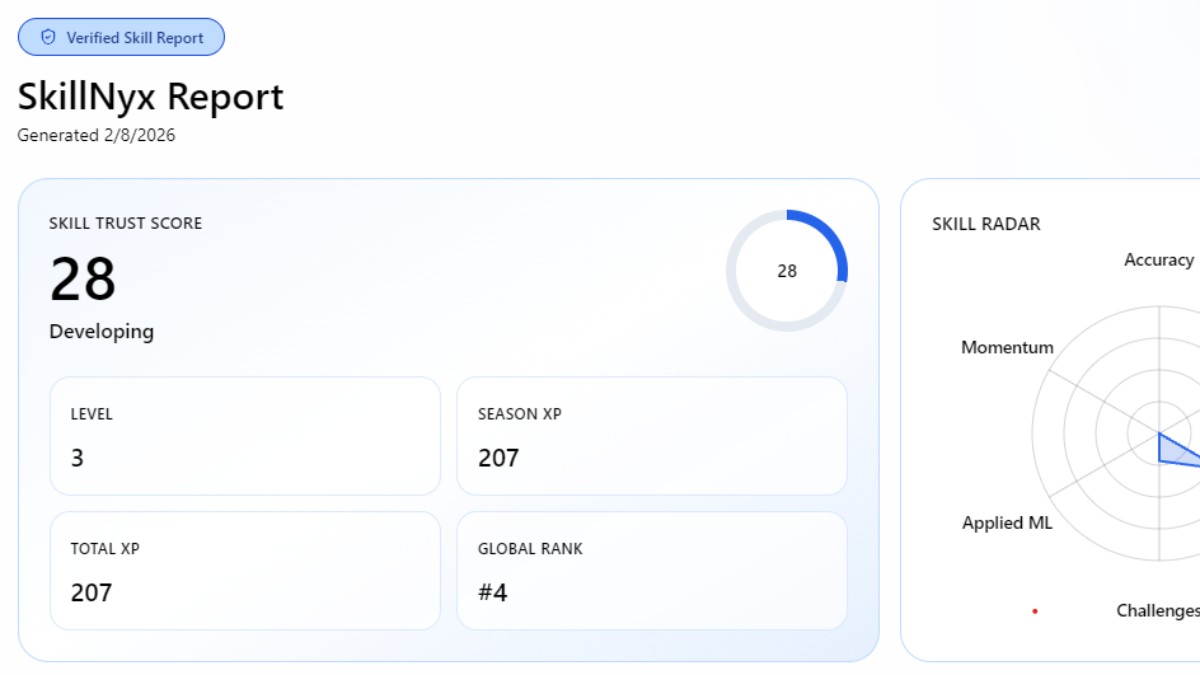
3) Skill Report + Certifications that recruiters can trust
A SkillNyx Skill Report can include:
verified skill bands (foundation → advanced)
attempts, improvement trend, consistency
artifacts (projects, PR curves, dashboards)
certification status (role-aligned)
And then a recruiter sees something like:
Trust Score: 82/100
SQL Analytics: Strong
Python: Working
Communication: Strong
Proof: 3 links + verified results
A certification becomes credible when it’s tied to observable work—not just a badge.
Trust Score: the recruiter’s shortcut (without being unfair)
“Trust Score” should not be portrayed as a mysterious AI number. It must be explainable.
Make it transparent and fair:
performance in assessments (accuracy)
performance in challenges (correctness + efficiency)
lab outcomes (metrics + artifact quality)
consistency (repeatability, not just one attempt)
integrity checks (anti-cheat + proctor signals if used)
The point: recruiters aren’t looking for perfect humans. They’re looking for lower risk.
Hiring is risk management.
Scorecards + trust signals are the new insurance.
Why this matters to companies: wrong hires are expensive
You said it right: wrong hires can cost millions.
Even without quoting exact numbers, the logic is obvious:
onboarding time + manager time
team velocity drops
missed deadlines and rework
customer dissatisfaction
replacing the hire = repeat cost
Recruiters and leaders don’t want “best resume.”
They want “most reliable performer.”
A proof-based scorecard is the fastest path to that.
What a “SkillNyx-ready” scorecard looks like (example snippet)
Target Role: Junior Data Analyst
SQL: Strong (Validated: Assessment 86%, Challenge pass rate 9/10)
Excel/Sheets: Advanced (Validated: timed test + case study)
Dashboarding: Working (Proof: Power BI dashboard link)
Business Insight: Strong (Validated: case study write-up)
Trust Score: 80+
Certifications: SkillNyx Certified – Data Analyst (L1)
That is recruiter-friendly. Clear. Verifiable. Fast.
Closing: Scorecards don’t replace talent. They reveal it.
The resume era rewarded people who could describe themselves best.
The scorecard era rewards people who can prove capability.
If you’re early in your career, that’s great news: you don’t need brand names or referrals. You need proof.
In skill-first hiring, credibility is built—link by link.