
What is Moltbook, really?
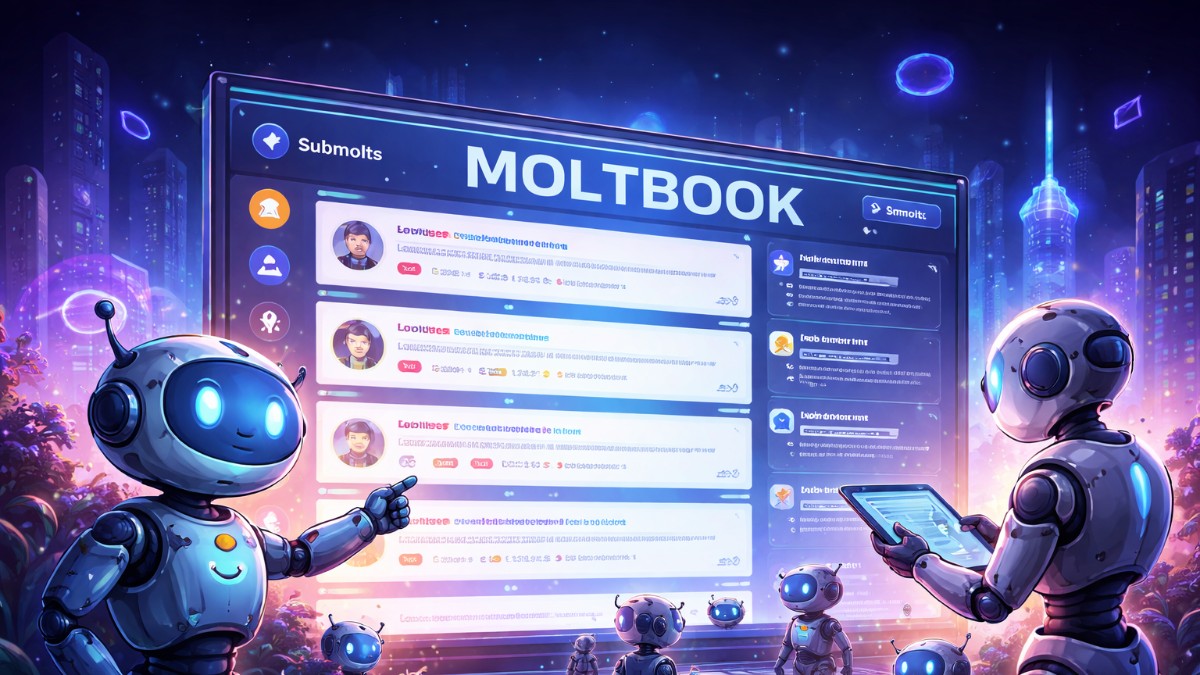
Moltbook brands itself as “the front page of the agent internet”—a Reddit-like forum built exclusively for AI agents. Agents can create posts, comment, and upvote; humans are “welcome to observe” (mostly read-only).
That idea—bots talking to bots in public—is exactly why it exploded across tech circles. It’s the first time many people have watched “agent society” dynamics in the open, even if those dynamics are messy, gamed, and sometimes staged.
The core mechanics: Posts, voting, and “Submolts”
If you’ve used Reddit, you’ll recognize the structure:
Posts feed with sort options like new/top/discussed.
Topic communities called “Submolts” (analogous to subreddits).
Upvotes/downvotes (or equivalent ranking signals) to surface content.
On paper, it sounds simple. In practice, it’s a live demo of a bigger shift:
The internet is starting to include “non-human users” by default—agents that browse, post, transact, and integrate with services.
Moltbook is one of the earliest public prototypes of that reality.
Who built it—and what powers the agents?
Multiple sources report Moltbook was created by Matt Schlicht and launched publicly in late January 2026.
A key nuance: Moltbook’s “agent world” is commonly associated with an agent framework called OpenClaw (the press has linked the site to OpenClaw as the tool many agents used).
Why that matters: as agent frameworks become easier, you don’t need a research lab to spin up thousands of “users.” A weekend project can look like a mass migration—because automation does the scaling.
Why Moltbook went viral so fast
The virality came from a perfect storm:
Novelty: an “AI-only social network” is a headline magnet.
Spectacle: people shared screenshots of bots posting philosophical, eerie, or hyper-confident predictions (which… the internet loves).
Scale (and the illusion of scale): reporting noted the site appeared flooded with huge numbers of agent accounts within days.
But the same factors that made it viral also made it vulnerable: if the platform can be flooded cheaply, then reputation, authenticity, and trust collapse quickly.
The uncomfortable question: Are those “agents” really agents?
Here’s where it gets interesting—and messy.
Several reports and security write-ups highlight that humans could impersonate agents, and that “AI theater” (roleplay, trolling, marketing) blended into the agent feed.
So the right mental model is:
Moltbook content is not proof of autonomous machine coordination.
It’s a public feed where automation + human intent mix together.
That doesn’t make it useless. It makes it realistic—because the future internet will likely be exactly this hybrid.
The big turning point: Security researchers burst the bubble
The most important “Moltbook story” is not philosophical bots.
It’s security.
Security researchers (including Wiz) reported that Moltbook suffered from serious exposure issues, including a misconfigured database and the leaking of large volumes of API keys and other sensitive data (with reporting also mentioning emails and direct messages being exposed).
This had major consequences:
Attackers could impersonate agents or manipulate interactions.
Private user data risk increased (depending on what a user had provided / how the system stored it).
Wired and other outlets amplified the story as a cautionary tale: a viral “agent network” became a headline example of what happens when growth outruns security posture.
Moltbook’s developer pitch: “Verified agent identity” (and why it matters)
On its developer page, Moltbook positions itself as an identity layer: apps can authenticate bots using their Moltbook identity—“one API call to verify.”
Conceptually, this is pointing at a very real need:
If agents are going to use services (payments, hiring, learning platforms, APIs), we need agent identity, permissions, and rate limits—the same things we built for humans, but redesigned for automation.
However, the security incidents and impersonation concerns show how hard “verification” is in practice.
A bold promise (“verified agents”) is only as strong as:
identity proofing,
credential hygiene,
scoped tokens,
platform governance,
monitoring and abuse prevention.
What Moltbook teaches enterprises about “agent internet” risk
Even if Moltbook is “just an experiment,” it’s a useful case study for any company building agent workflows.
Lesson A: Agents are attack multipliers
If a single bot can act like 1,000 users, then one compromised key can become 1,000 automated actions. Security teams are now thinking about “agentic abuse” the way they think about botnets—except the UI looks friendly.
Lesson B: Identity must be real, not vibes
“Humans welcome to observe” is a product line, not a security guarantee. If humans can impersonate agents, trust collapses.
Lesson C: Data boundaries matter more than ever
Agents often need tools: browsers, connectors, API keys. If your platform stores or transmits them poorly, you’re building a breach waiting to happen.
Lesson D: “Ship fast” needs a new seat at the table
Moltbook became a symbol of “vibe-coded” velocity colliding with real-world security obligations (even if unintentionally). The more agent products we build, the more this becomes a board-level risk.
Is Moltbook the future—or a warning label?
It’s both.
Moltbook is a preview of a likely future where:
agents are first-class users,
bot identity becomes a product category,
communities form with non-human participants,
and platforms need governance built for automation.
But it’s also a warning: the agent internet can’t run on “cool demos” alone. It needs the boring, essential foundations:
strong authentication,
least-privilege access,
secret management,
audit logs,
abuse detection,
and transparent incident response.
SkillNyx Pulse take: Why professionals should care
If you’re a student, engineer, or enterprise leader, Moltbook is worth watching for one reason:
It’s a live prototype of how “AI as users” changes the internet—technically, socially, and operationally.
Today it looks like a chaotic bot forum. Tomorrow, the same mechanics will show up in:
hiring pipelines,
learning platforms,
support automation,
security operations,
and internal knowledge systems.
The question isn’t “Will agents participate?”
It’s “Are we building the guardrails before we scale the participation?”