
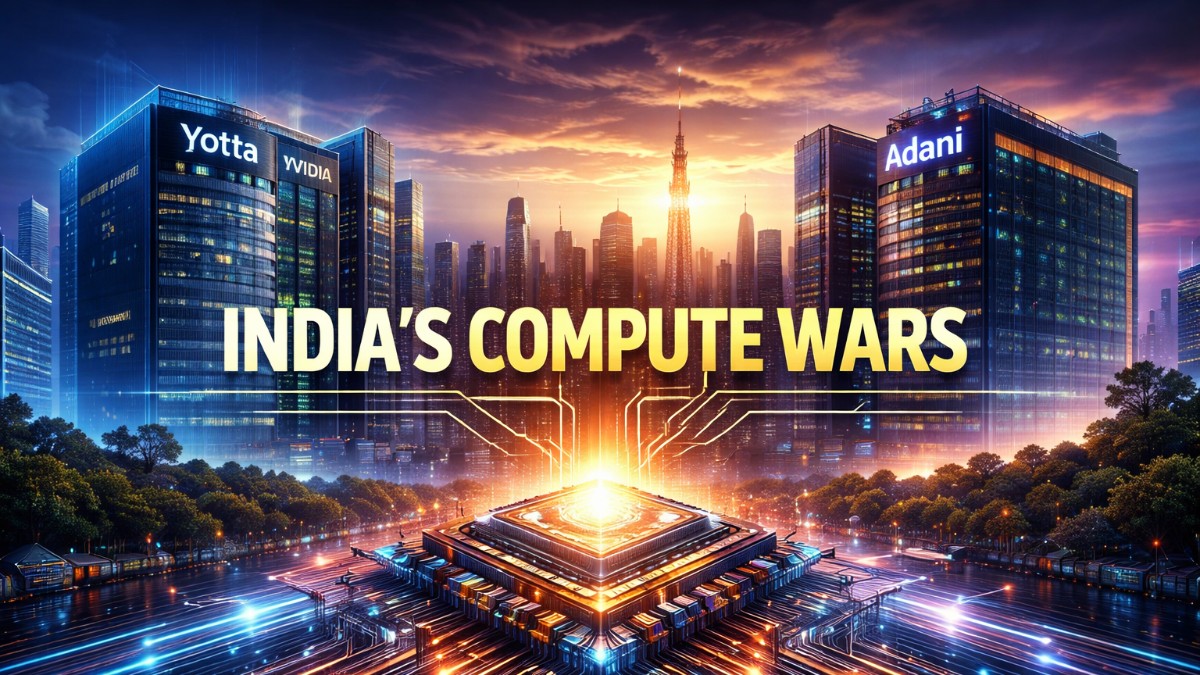
India’s loudest AI conversation still sounds like apps: chatbots, copilots, agents, “AI inside everything.” But under the surface, the real contest is far less glamorous—and far more decisive.
It’s about compute.
The next decade of Indian AI will be shaped less by who ships the flashiest demo and more by who controls the underlying machinery: GPUs, power, cooling, racks, fiber, data halls, and the capital required to keep them running at scale. That’s why announcements around AI data centers and large GPU clusters are turning into the new headlines—and why the country’s largest infrastructure players are entering the arena.
AI is not just software anymore. It’s industrial.
The winners will be the ones who can build and operate machines at the scale of cities.
The new battleground: compute is the moat
In the early cloud era, the advantage came from owning servers and selling elastic storage. In the AI era, the advantage comes from owning accelerated compute—high-end GPUs and the supporting infrastructure needed to keep them fed with data and electricity.
This shift changes everything:
AI models don’t scale like normal apps. Training and serving advanced models is compute-hungry and power-hungry.
GPUs are supply-constrained and expensive. Access matters as much as talent.
Latency and data residency matter. Many Indian enterprises want workloads closer to home for performance, cost predictability, and compliance comfort.
AI demand isn’t a spike—it’s structural. Every enterprise function is being rebuilt with AI layers, and that creates persistent compute demand.
So when large Indian players talk about AI hubs and data-center expansion, they’re not “joining the AI trend.” They’re building the new industrial base behind it.
What Yotta represents: a “compute-first” India pitch
Yotta’s positioning is essentially: India needs dependable, local, enterprise-grade GPU capacity, not just imported AI services.
If this direction works, it creates a powerful ripple effect:
1) Startups get faster time-to-market
When GPU access is local and dependable, startups can iterate without waiting in long provisioning queues or paying premium global rates during peak demand.
2) GCCs can industrialize AI faster
Global Capability Centers (GCCs) in India are shifting from “support functions” to “build functions.” But real AI delivery needs stable infrastructure: model evaluation, fine-tuning, vector search, high-throughput inference, monitoring.
Local compute strengthens that operating model.
3) Indian enterprises get predictable AI economics
A big pain point with AI adoption is bill shock. Compute built for India—priced, supported, and capacity-planned for India—can make AI budgets less volatile.
“Compute is not just capacity; it’s confidence.”
If teams can’t trust they’ll have GPUs when they need them, they won’t commit core workflows to AI.
What Adani represents: AI infrastructure as a national-scale play
Adani’s entry signals something different: AI data centers as core infrastructure, on the same strategic level as ports, airports, power, and logistics.
That matters because AI at scale is not simply “renting servers.” It becomes a full-stack infrastructure equation:
Power generation and power contracts
Land + speed of approvals
Cooling systems + water strategy
Fiber routes + redundancy
Security + compliance controls
Operational uptime at enterprise SLAs
Few groups can orchestrate that end-to-end. That’s why a major infrastructure conglomerate stepping in can accelerate the timeline of what’s possible—if executed well.
The truth: AI is becoming a power-and-capital game
There’s an uncomfortable reality here, and it’s worth saying plainly:
The future of AI will be constrained by electricity, not imagination.
If India’s compute buildout scales responsibly, it could pull AI innovation forward across sectors—healthcare, BFSI, manufacturing, retail, education—because the infrastructure will be there to support production-grade systems.
But compute wars also create new risks:
Risk 1: Concentration
If GPU capacity consolidates into a few providers, pricing power rises, and smaller builders can get squeezed.
Risk 2: Overbuild vs underutilization
If capacity is built ahead of demand without clear workload pipelines, utilization suffers. Data centers are not cheap hobbies.
Risk 3: Talent mismatch
Compute without builders is dead weight. India’s shortage may shift from “not enough GPUs” to “not enough people who can run AI systems in production.”
What this means for India’s AI ecosystem (practically)
Here’s the on-the-ground impact you’ll likely see over the next 12–24 months:
1) AI pricing will start to normalize
As domestic capacity grows, the market becomes less dependent on global supply cycles. This can reduce volatility in inference pricing—especially for enterprise workloads.
2) Model-building will become more common inside India
Not just using models—fine-tuning, domain adaptation, evaluation pipelines, safety and governance layers—because the infrastructure is closer and the economics are clearer.
3) “AI Ops” becomes a mainstream job category
The biggest hiring wave won’t be only “prompt engineers.” It will be:
ML/AI platform engineers
model evaluators and red-teamers
observability + monitoring specialists
cost governance owners (“FinOps for AI”)
data reliability and pipeline engineers
4) A new enterprise buying pattern emerges
Enterprises will increasingly ask vendors:
Where does inference run?
What are data residency guarantees?
What’s the throughput SLA?
What’s the failover plan?
How do you control cost per transaction?
This pushes the ecosystem from “AI demos” to AI delivery.
The SkillNyx angle: compute wars create a skill war
If compute is the new moat, then skills are the new currency. The biggest bottleneck is no longer “Do we have an idea?”—it’s:
Can you deploy?
Can you evaluate models reliably?
Can you track drift and hallucinations?
Can you optimize cost per inference?
Can you build safe and compliant workflows?
That’s why the next generation of AI talent will be judged less by certificates and more by proof-of-skill: real labs, real systems thinking, real performance constraints.
The new resume is a shipped system.
The new interview is a reproducible benchmark.
Bottom line
India’s AI story is moving from “applications” to “industry.”
Yotta’s compute-first narrative and Adani’s infrastructure-scale ambition aren’t just business headlines—they’re signals that India is trying to control the foundation layer of AI: the metal, the power, the uptime, the economics.
And once that foundation expands, everything above it accelerates—startups build faster, GCCs deliver bigger programs, enterprises adopt with more confidence, and the talent market shifts toward builders who can operate AI in the real world.
In the AI era, the country that controls compute controls compounding.
India’s compute wars have begun—and the outcome will shape who gets to build, who gets to scale, and who gets left behind.