India’s Union Budget 2026–27 sends a clear signal: education is no longer being framed as a standalone “social sector.” It’s being treated as an economic engine—one that must translate learning into employability, enterprise, and globally relevant skills, especially in services and technology.
The headline isn’t just “more money.” It’s the architecture: new hubs, creator labs, AI-and-services workforce planning, and skilling pipelines that target where jobs are moving, not where they used to be.
The big shift: Education is being positioned as a feeder system for services, health, tourism, design, and digital creation—with “skills + outcomes” at the center of the story.
1) The numbers: Education allocation rises, and higher-ed gets a sharper push
The Ministry of Education’s Budget Estimate for 2026–27 is ₹1,39,289.48 crore, described as an 8.27% increase over BE 2025–26.
Within that, the official Ministry note breaks out:
Department of School Education & Literacy (DoSEL): ₹83,562.26 crore (up 6.35%)
Department of Higher Education (DHE): ₹55,727.22 crore (up 11.28%)
Why that matters: the higher growth rate in higher education signals focus on capacity building—research, STEM clusters, specialized institutes, and employability-linked skilling pathways.
2) “Education to Employment & Enterprise”: a Standing Committee with an AI lens
One of the most consequential announcements is a proposed high-powered Standing Committee focused on the services sector, and explicitly tasked to look at the impact of emerging technologies (including AI) on jobs and skill requirements.
That’s not a small bureaucratic footnote—it’s an admission that:
Skills demand is changing faster than degree structures.
AI will reshape roles, not just replace tasks.
Workforce planning can’t be left to guesswork.
If this Standing Committee becomes active and data-driven, it could set the direction for what “job-ready” means in India over the next few years.
3) Five “University Townships”: education hubs near industrial & logistics corridors
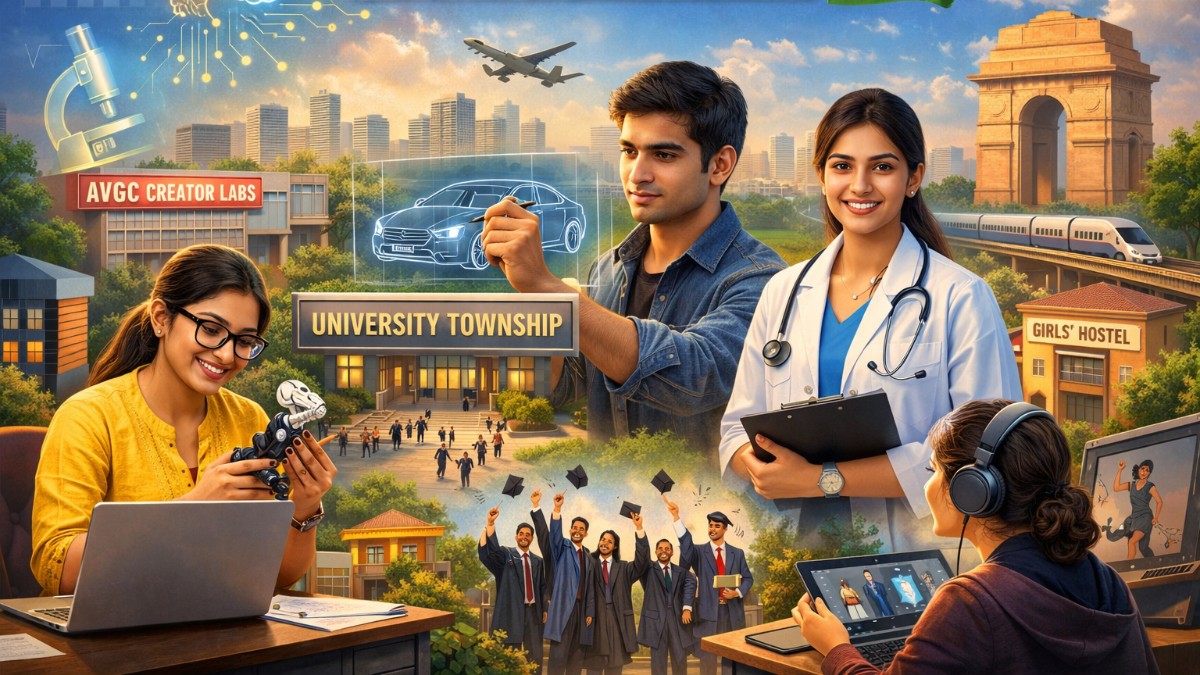
Budget coverage and official references point to five university townships—integrated clusters that can host universities, colleges, research institutions, skill centers, and residential complexes, located near industrial and logistics corridors with state support.
This is a “campus city” model—less isolated academia, more proximity to:
factories and manufacturing ecosystems,
logistics and supply chains,
service hubs and tech corridors,
labs, apprenticeships, and industry projects.
SkillNyx take: If these townships are executed well, they can become proof-of-skill zones—where students build portfolios, ship projects, and graduate with work samples, not just marksheets.
4) Creator economy enters the curriculum: AVGC Creator Labs at scale
The Budget proposes supporting the Indian Institute of Creative Technologies (IICT), Mumbai to set up AVGC (Animation, Visual Effects, Gaming & Comics) Content Creator Labs in 15,000 secondary schools and 500 colleges.
This is important for two reasons:
Jobs: AVGC is not “just entertainment.” It touches gaming, marketing, education content, simulation, AR/VR training, digital twins, and media exports.
Skills format: AVGC skills are inherently portfolio-based—your work is visible and testable.
When government-backed infrastructure meets portfolio-driven hiring, you get a pathway where proof links matter more than pedigree.
5) A girls’ hostel in every district: access as an employability strategy
The Budget highlights one girls’ hostel in every district (with capital/VGF support referenced), addressing a real bottleneck: higher-ed access, especially for STEM where schedules and lab hours can be intensive.
This is not just a “welfare” line item. It’s a workforce participation lever:
increasing female enrollment and retention,
supporting mobility for higher education,
enabling longer-duration programs (labs, internships, residencies).
6) Healthcare + allied skills: a massive job pipeline in plain sight
Budget coverage includes major skilling intent in health-related sectors:
Ten allied health disciplines (including optometry, anesthesia, applied psychology, behavioral health, etc.) with a target to train one lakh allied health professionals over five years.
References also include expanding wellness/yoga services caregivers and broader health training initiatives in coverage.
Healthcare is often discussed as “doctors and nurses,” but allied health roles are where scale hiring happens. For students, these are clear, structured pathways—with certifications, practical skills, and defined outcomes.
7) Tourism skilling: IIM-linked guide training (and why it matters)
A pilot scheme is mentioned to upskill 10,000 tourist guides across 20 iconic tourist sites, via a standardized 12-week hybrid training in collaboration with IIMs.
This is a good example of the Budget’s broader model:
short, modular, outcome-based training,
recognized institutional involvement,
direct link to service-sector jobs.
For SkillNyx, this validates the idea that the future is not “one 3-year course.” It’s stackable skill blocks + proof + employability.
What this means for students (and parents): the “proof-first” decade is accelerating
If you’re a student in 2026, here’s the practical reality:
Degrees still matter—but they won’t be sufficient
Budget messaging is nudging education toward employability and measurable outputs.
Your advantage will be visible work
Whether it’s AVGC labs, tech projects, allied health competencies, or tourism service skills, the signal is consistent: build proof.
AI isn’t a separate subject anymore
The Standing Committee explicitly includes AI’s impact on jobs and skills. That’s policy language aligning with what the market already did.
What institutions should do next: don’t wait for circulars
Colleges and training centers that move early can win:
Industry-linked projects (real datasets, real problems, real deliverables)
Portfolio + assessment (rubrics, skill scorecards, publishable outcomes)
Micro-credentials aligned to services + AI + domain needs
The SkillNyx lens: turning Budget intent into real employability
Budget announcements create infrastructure and direction. Platforms like SkillNyx can make it usable for learners through:
Skill-first assessments mapped to job roles (services, AI-augmented roles, healthcare, AVGC pipelines)
Proof-of-skill profiles: portfolio links, verified tasks, scorecards
Micro-learning playbooks aligned to modular training formats (like the 12-week tourism model)
The winning formula for 2026 isn’t “study harder.” It’s learn → build → prove → get hired.
A simple action plan for learners this month
If you want to align yourself with the direction of Budget 2026–27, do this:
Pick one employable track (AI + services, AVGC, allied health support roles, analytics, digital operations).
Build 2 proof artifacts (a project, a case study, a portfolio piece).
Take one standardized assessment and publish the score/skill breakdown.
Convert your resume into proof links: GitHub, portfolio, labs, scorecards.
Apply to internships/apprenticeships with your proof attached.
Bottom line
Budget 2026–27 is pushing education into a sharper, outcome-led frame: skills, AI readiness, and service-sector employability, backed by increased allocations and large-scale capacity-building initiatives (townships, labs, hostels, modular training).
If you’re building a career in this decade, the message is simple: don’t just learn—show.