AI isn’t “the IT team’s thing” anymore. It’s becoming everyone’s tool.
For years, AI and ML sounded like a software-company obsession—something happening inside Big Tech, built by engineers, used by product teams, and discussed in tech conferences.
That era is over.
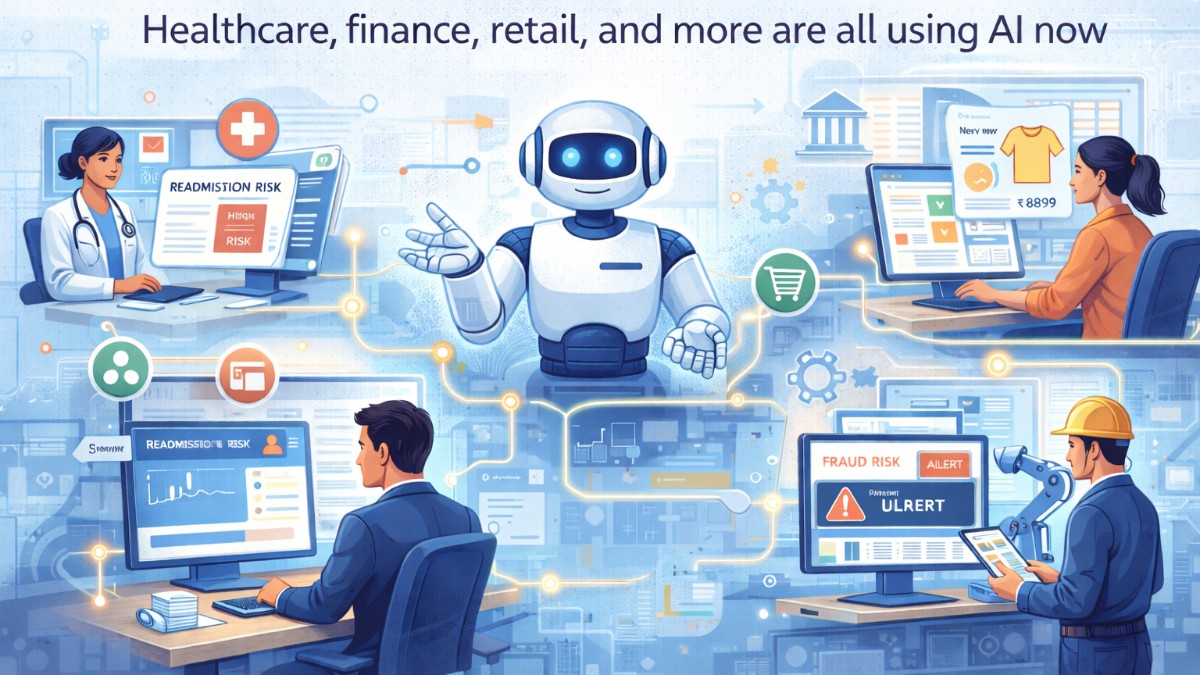
In 2026, AI and ML are increasingly embedded inside everyday business workflows—from hospitals and banks to retail chains and factories.
AI is no longer a department.
It’s becoming a layer across operations.
And that changes career paths—especially for people who don’t consider themselves “tech.”
What changed: AI moved from “projects” to “process”
Earlier, AI was often treated as an innovation project:
a pilot model
a small research team
a dashboard demo for leadership
Now it’s evolving into something more practical:
a fraud score that blocks a transaction
a claim that gets prioritized for review
a warehouse that reorders stock automatically
a chat agent that resolves customer tickets
a scheduling system that predicts staffing needs
AI has become operational infrastructure.
Where AI/ML is already normal outside IT companies
Let’s make it real with examples you can recognize.
Healthcare (Hospitals, Clinics, Insurance)
Claims anomaly detection (flag unusual billing patterns)
Readmission risk (identify high-risk patients for follow-up)
Queue prediction (reduce OPD waiting time)
Document automation (extract data from forms, prescriptions)
Banking & Fintech
Fraud detection (card-not-present, account takeover)
Credit risk scoring (default likelihood)
Collections prioritization (who needs follow-up first)
AML monitoring (suspicious transaction patterns)
Retail & E-commerce
Demand forecasting (predict what sells next week)
Dynamic pricing (optimize price based on market)
Inventory optimization (reduce stockouts)
Personalization (recommendations and offers)
Manufacturing & Supply Chain
Predictive maintenance (machine failure prediction)
Quality inspection (detect defects via vision systems)
Route optimization (delivery efficiency)
Procurement risk (supplier delay prediction)
HR, Admin & Operations
Attrition prediction (who might leave and why)
Resume screening (skill-first scoring)
Scheduling (staffing vs demand)
Process automation (ticket routing, approvals, compliance checks)
None of this requires the company to be “an IT organization.”
It requires the company to be serious about speed, cost, and accuracy.
The biggest myth: “You need to be an ML engineer to work with AI”
No.
In most organizations, the highest value roles around AI are not only model builders. They are:
people who define the business problem clearly
people who prepare data reliably
people who interpret model outputs correctly
people who design processes around AI decisions
people who measure outcomes and improve systems
AI success is 50% model, 50% operations.
That means non-IT professionals can become highly valuable by learning:
how AI decisions are made
how metrics work (precision/recall, false positives/negatives)
how to spot bias and data quality issues
how to convert outputs into business actions
AI literacy is the new workplace literacy
Just like Excel became a universal skill across industries, AI literacy is becoming the new baseline.
Not “how to build GPT.”
But:
how to ask better questions
how to validate outputs
how to use tools responsibly
how to avoid costly mistakes
In the next few years, the gap won’t be “AI vs non-AI.”
It will be AI-literate vs AI-blind.
What non-IT professionals should learn (the practical list)
1) Data thinking
What is a feature?
What makes data reliable?
Why “garbage in, garbage out” still kills AI projects
2) Metrics that matter
Precision vs recall (depends on risk)
False positives/false negatives (business cost)
Thresholds (decision tuning)
3) Workflow integration
Where does AI fit in the process?
Who approves decisions?
When should humans override AI?
4) Proof-of-skill artifacts
Instead of saying “I know AI,” show:
a mini case study
a dashboard with insights
a lab result (metrics + interpretation)
a process improvement using automation
This is skill-first proof.
How SkillNyx helps (position it as enablement, not hype)
SkillNyx can make AI approachable through:
role-based labs (fraud, healthcare ops, retail demand)
guided projects (step-by-step, with real-world framing)
assessments that test concepts and decision-making
Skill Reports & Certifications that turn learning into proof
The aim isn’t to turn everyone into a data scientist.
It’s to make professionals AI-capable in their roles.
Closing
AI and ML are no longer “only for IT organizations.” They are becoming business tools—embedded in processes that run hospitals, banks, retailers, and supply chains.
If you’re non-IT, that’s not bad news. It’s an advantage.
Because the next wave of high-value professionals won’t only build AI.
They’ll know how to use it, validate it, and turn it into outcomes.
AI is not replacing non-tech roles.
It’s upgrading them.