The interview isn’t just a conversation anymore. It’s an evaluation system.
For decades, interviews were mostly human judgment: chemistry, confidence, and a handful of technical questions. That still exists—but a new participant is quietly entering the room:
An intelligent evaluator that listens, scores, validates, and guides the next question.
In many hiring flows today, AI already supports screening (shortlisting, assessments, async interviews). The next step is obvious: AI during live interviews—not as a replacement for humans, but as a panelist that reduces risk and improves consistency.
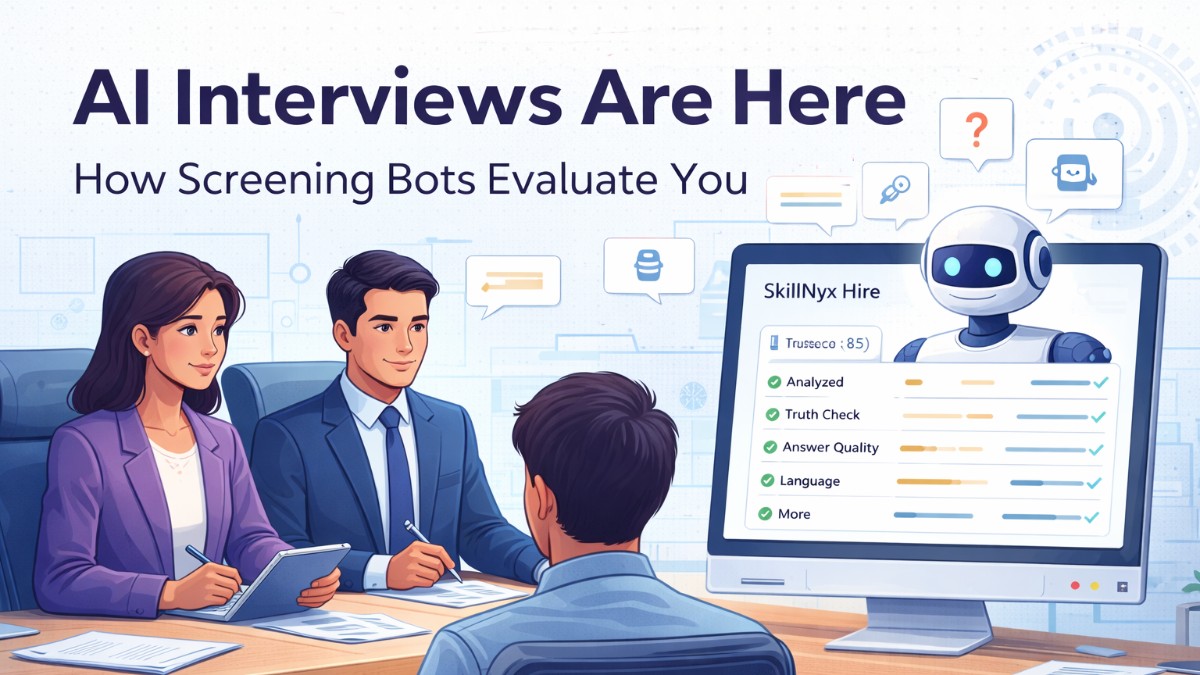
This is where SkillNyx Hire fits in: a hiring assistant that can join interviews as a panelist, evaluate the conversation for quality and truthfulness signals, assess language proficiency, and suggest next questions dynamically.
Why companies are adding AI to interviews
The reason is not “automation for the sake of it.” It’s risk.
Hiring a wrong candidate is expensive in ways that don’t show up on the offer letter:
onboarding time wasted
manager bandwidth drained
team delivery slows down
customers feel the impact
rehiring repeats the cost
So companies want interviews that are:
more consistent (less dependent on interviewer mood)
more verifiable (less dependent on confidence)
better documented (clear evaluation trail)
AI panelists don’t get tired, don’t forget to ask key questions, and don’t rely on “gut feel” alone.
What screening bots actually evaluate (beyond “right answers”)
A good AI evaluator doesn’t just check if you said the correct thing. It checks whether you are credible, coherent, and role-ready.
1) Clarity and structure
Bots measure how clearly you communicate:
Do you answer the question directly?
Do you structure your explanation?
Do you use examples and outcomes?
Do you ramble or loop?
A simple difference matters a lot:
“I know SQL.” (weak)
“I used SQL window functions to identify churn cohorts and reduced query time by 30%.” (strong)
2) Consistency across the conversation
Humans miss contradictions. Bots don’t.
If you said:
“I led the project end-to-end”
and later:“My teammate handled deployment; I mostly supported”
That may be true—but it needs clarity. AI flags gaps and asks follow-ups.
3) Depth of understanding (not just keywords)
Modern candidates can speak fluent buzzwords. Bots look for depth:
“Can you explain why you chose that approach?”
“What tradeoff did you accept?”
“What would you do differently next time?”
4) Proof orientation
Bots increasingly favor candidates who provide:
artifacts (links, demos, case studies)
specific outcomes (time saved, errors reduced, revenue impacted)
measurable results (accuracy, latency, conversion, SLA)
This aligns perfectly with SkillNyx’s “proof-first” model.
5) Language proficiency and professional communication
For many roles, language is not “nice to have.” It’s operational:
client calls
documentation
cross-team collaboration
AI can assess:
grammar and readability
vocabulary range
confidence vs aggression
tone, interruptions, filler words
listening and response relevance
In AI-assisted interviews, “communication” is no longer a vibe. It becomes a measurable signal.
SkillNyx Hire: the interview panelist that keeps interviews honest, consistent, and skill-based
Here’s how to articulate SkillNyx Hire without sounding like hype: position it as an augmented panelist.
What SkillNyx Hire does in the live interview
1) Validates claims in real-time (truth + consistency checks)
If you claim experience, the bot can ask targeted follow-ups:
“What metric improved?”
“What was your exact responsibility?”
“How did you measure success?”
“What tools did you use and why?”
This doesn’t “accuse.” It simply turns claims into verifiable evidence.
2) Evaluates conversation quality
SkillNyx Hire can score:
clarity
relevance
conciseness
completeness
confidence vs uncertainty language
3) Assesses language proficiency
Not “accent policing”—but professional communication:
structured answers
vocabulary fit for role
ability to explain complex ideas simply
writing-friendly articulation (for documentation-heavy roles)
4) Suggests the next best question
This is the most powerful part: adaptive interviewing.
Instead of a static list, the bot can recommend:
deeper questions when the candidate is strong
clarification when answers are vague
role-fit scenarios based on what’s missing
The interview becomes a guided evaluation—like a smart navigation system, not a random walk.
5) Produces a clean interview report (skill report + trust signals)
After the interview, SkillNyx Hire can generate:
strengths / risks
evidence snippets (paraphrased, structured)
skill readiness score by category
recommended next step (hire / next round / reject)
This creates a consistent decision trail—especially valuable for leadership and compliance.
The new interview reality: you’re being evaluated on how you think
In AI-assisted interviews, the winning pattern looks like this:
you answer with structure (Situation → Action → Result)
you give specific examples
you quantify outcomes when possible
you admit limits honestly (and show how you learn)
you stay consistent across the session
AI doesn’t punish honesty. It punishes vagueness.
How to prepare for AI-assisted interviews (practical checklist)
1) Replace buzzwords with a “proof sentence”
For every skill on your resume, prepare:
Tool + Action + Outcome
Example:“Python + automated reconciliation + reduced manual effort by 40%.”
2) Practice 60–90 second answers
Long answers reduce clarity score. Train for concise delivery:
1-line context
2–3 key actions
1 measurable result
1 lesson
3) Build a personal consistency map
Be consistent on:
your role
your responsibilities
project outcomes
tools used
If something changes (“I led” vs “I supported”), explain the nuance clearly.
4) Prepare “why” and “tradeoff” answers
Bots love this because it reveals real understanding:
“Why did you choose X over Y?”
“What tradeoff did you accept?”
5) Strengthen language fundamentals
Even small improvements matter:
short sentences
fewer filler words
clear transitions (“first… then… finally…”)
summarize at the end
Why SkillNyx matters here: proof + validation before the interview
The easiest way to perform well in AI-assisted interviews is to have real proof before you enter the room:
assessments that confirm fundamentals
coding challenges that prove problem-solving
ML labs/projects that show applied skill
skill scorecards and certifications that add credibility
Then the interview becomes what it should be:
A confirmation of readiness—not a gamble.
This connects naturally to SkillNyx’s ecosystem:
you build proof on SkillNyx
SkillNyx Hire verifies and evaluates in the interview
recruiters get a clearer trust signal
candidates get a fairer evaluation
Closing
The interview is changing, but the rule is still simple:
If your skill is real, AI helps you.
If your skill is only words, AI exposes the gap.
In 2026, the “intelligent evaluator on board” is not a future idea. It’s the direction hiring is moving—because organizations can’t afford to guess.