The chatbot fight just went public—and it’s about ads.
This week, two of the biggest AI assistant companies stopped competing quietly and started arguing in the open.
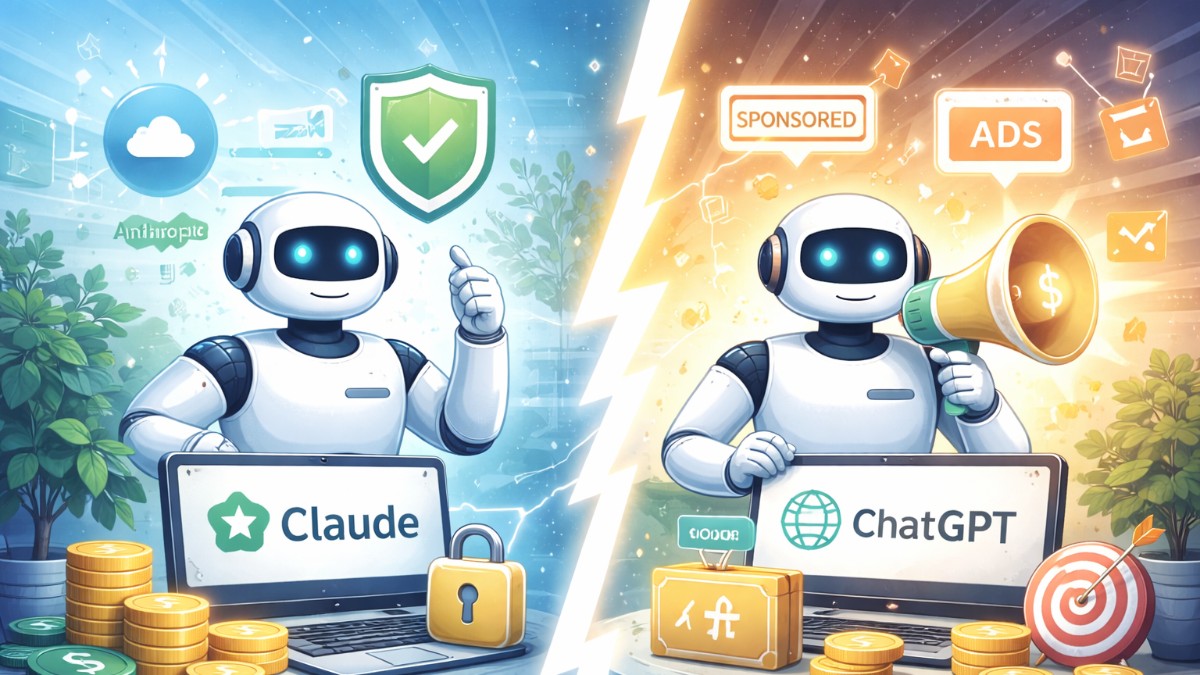
Anthropic launched a campaign that essentially says: ads are coming to AI, but not to Claude—warning that ad incentives could distort what an AI assistant says.
OpenAI’s Sam Altman responded publicly, calling the messaging misleading and defending the idea of clearly labeled, non-intrusive ads as a way to keep broad access affordable.
On the surface, it looks like a Super Bowl-season marketing jab. Underneath, it’s a much bigger question:
Should an AI assistant be paid by you—or by advertisers?
Why this isn’t just a branding fight
AI assistants are expensive to run. Someone pays—either:
Users (subscriptions),
Businesses (enterprise licensing), or
Advertising (free tier funded by brands).
Anthropic is leaning into model #1/#2: premium, ad-free, trust-first positioning—and argues ads create incentives that are incompatible with a genuinely helpful assistant, especially for sensitive topics.
OpenAI is leaning into scale: it has signaled a path where ads (clearly marked) could support free access, while paid tiers remain ad-free.
That difference—premium trust vs mass access—is the real split.
What “ads in chat” changes (even if they’re labeled)
Even if ads are clearly marked, chat is not a normal web page. It’s interactive, personal, and often used for high-stakes decisions.
In a chatbot interface, ads can influence:
what gets suggested first,
what tools or products are “recommended,”
how neutral the assistant feels.
That’s why Anthropic’s core argument is about incentives, not just aesthetics: if an assistant’s business model depends on advertisers, users may question whether it’s acting purely in their interest.
OpenAI’s counter-argument is essentially: it can be done transparently—with labeling, privacy constraints, and an ad-free subscription option—so that access remains broad.
Why this debate will shape the next decade of AI
This isn’t just about two companies. It’s about what AI becomes for everyone:
1) Trust becomes a competitive feature
“Ad-free” may become a premium signal the way it did with some consumer apps.
2) “Free AI” needs a funding model
If AI is expected to be widely accessible, ads (or something like ads) is one of the few models that can subsidize massive usage.
3) Regulation and disclosure pressure increases
As AI becomes a decision layer, pressure builds for clear disclosure: what is sponsored, what is neutral, and what data was used.
What this means for users (and job seekers)
If you use AI assistants daily—for learning, career prep, or building projects—this is the practical takeaway:
Ask: “Is this recommendation optimized for me—or for someone paying?”
And if you’re a student or candidate using AI to prepare for interviews or build portfolios, the standard is rising:
You’ll be judged on proof of skill, not just polished answers.
You’ll need to show your sources, reasoning, and artifacts.
(That’s the same shift happening in hiring: from “tell me” to “show me.”)
What this means for builders and startups
For founders and product teams, the clash signals a new product design reality:
If you introduce ads, you must design for trust, not just revenue.
If you go ad-free, you must justify premium value—and compete on outcomes.
And either way, you’ll need policies around:
sponsorship disclosure,
personalization limits,
data boundaries,
“ads cannot change answers” guarantees (and how that’s audited).
The bottom line
This is likely the first of many public battles over AI incentives.
Anthropic is betting that trust is the product.
OpenAI is betting that access at scale needs new monetization, and transparency can keep it ethical.
In the next phase of AI, the biggest feature won’t be a new model.
It will be who the assistant is built to serve.